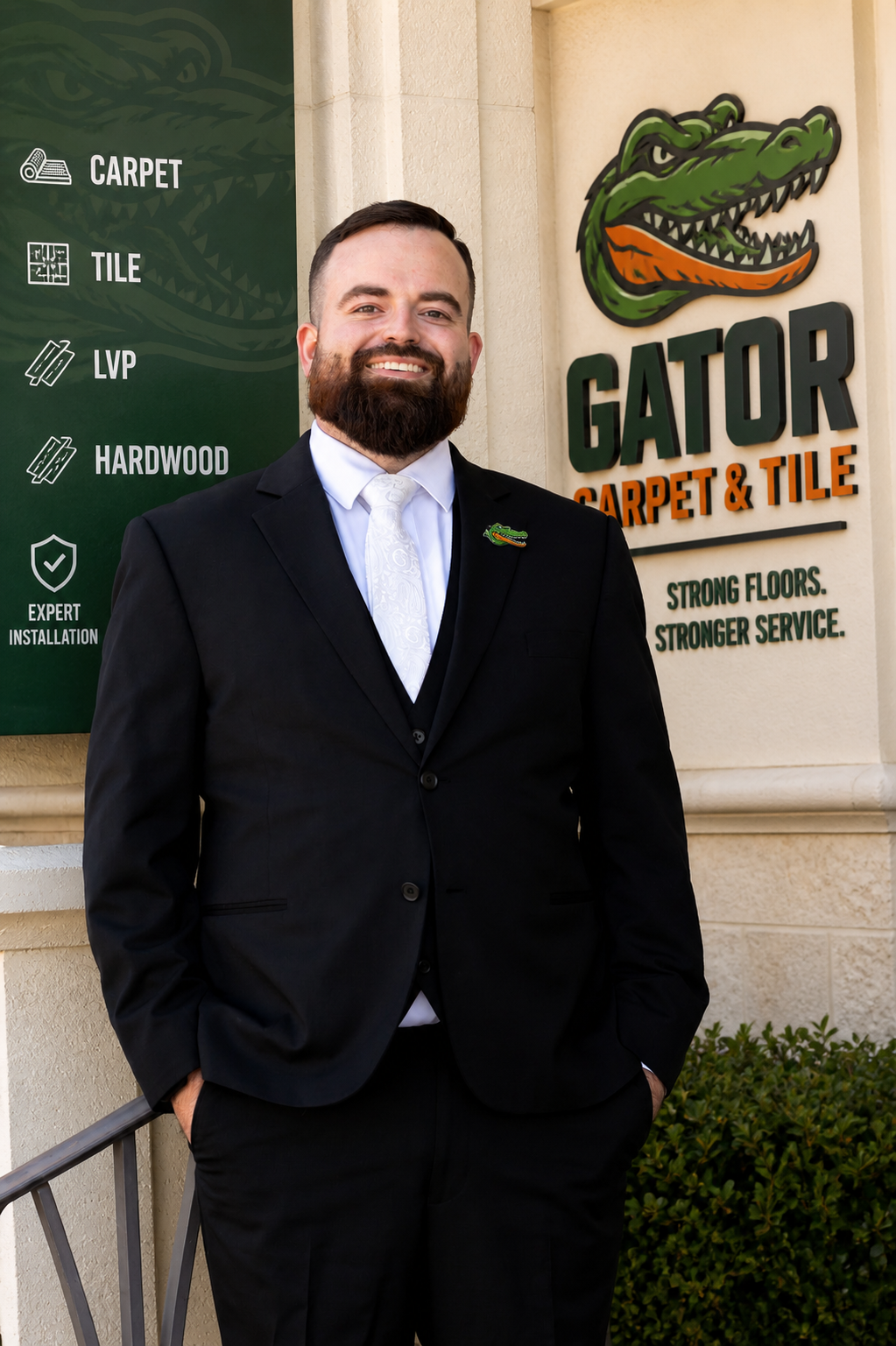
 By Shane Webb, Owner — Gator Carpet and Tile • 30+ years Jacksonville flooring experience
The hardwood vs LVP debate looks very different in Florida than it does in other parts of the country. In dry climates, solid hardwood can last 50+ years and be refinished multiple times. In Jacksonville and Northeast Florida, the math changes significantly.
Florida averages 70–80% relative humidity year-round. Hardwood is a natural material that expands when it absorbs moisture and contracts when it dries out. On a concrete slab — which is how most Florida homes are built — moisture wicking up through the slab is a constant concern that hardwood simply wasn't designed to handle.
Luxury vinyl plank, by contrast, is a 100% synthetic product. It doesn't absorb moisture, doesn't expand or contract with humidity changes, and can be installed directly over concrete slabs without a moisture barrier in most cases.
Hardwood isn't impossible in Florida — it just requires the right conditions. If your home has consistent HVAC running year-round, a properly sealed subfloor or crawl space, and you're committed to monitoring humidity, engineered hardwood can work.
Engineered hardwood — which has a real wood veneer over a stable core — performs better than solid hardwood in Florida. It's dimensional stability under humidity is much improved. But it still isn't waterproof and shouldn't be installed in kitchens, bathrooms, or over slabs with any moisture history.
If you want the look of hardwood without the risk, modern LVP is genuinely difficult to distinguish from real wood at typical viewing distances. Technology has come a long way in the last five years.
Solid hardwood is not ideal for Florida. High humidity causes expansion, cupping, and warping — especially on concrete slabs. Engineered hardwood performs better but still has limits in high-moisture environments.
LVP is not the same as hardwood — it's a synthetic product — but in Florida's climate it often outperforms hardwood in durability, moisture resistance, and long-term appearance. Most homeowners can't tell the difference visually.
LVP is significantly less expensive than hardwood both in material cost and installation. Quality LVP runs $3–7/sq ft installed vs $8–15+ for hardwood, depending on species and finish.
No — LVP cannot be sanded and refinished like hardwood. However, most quality LVP products are designed to last 20–30 years without showing significant wear under normal use.
We'll come out, look at your subfloor, and tell you exactly what will hold up — and what won't.
Get a Free Estimate Call 904-262-7304